

Many execution failures begin long before execution starts. They begin when important ideas are never transformed into coordinated action.
I saw this firsthand while working with a leadership team that had spent months developing an innovative strategy to provide emergency communications capabilities in disaster zones.
When Alignment Is an Illusion
The vision was compelling. The leaders believed they were aligned and were eager to begin implementation. When I suggested that the first step was to define the pilot project’s desired outcomes and key milestones in writing, they pushed back. Everyone already understood the goal. Why slow down when they could start moving?
But when we took the time to capture and refine ideas in writing, hidden assumptions emerged. Some leaders envisioned a packaged solution: equipment and capabilities that could be shipped directly to a disaster area and deployed immediately. Others envisioned an advisory service that would help responders build capabilities tailored to their own unique situations.
Both groups supported the same vision. Both thought they were aligned, yet they were describing fundamentally different solutions.
The ensuing discussions took weeks and were sometimes contentious. But they exposed critical differences before work began.

Five Questions Before You Execute
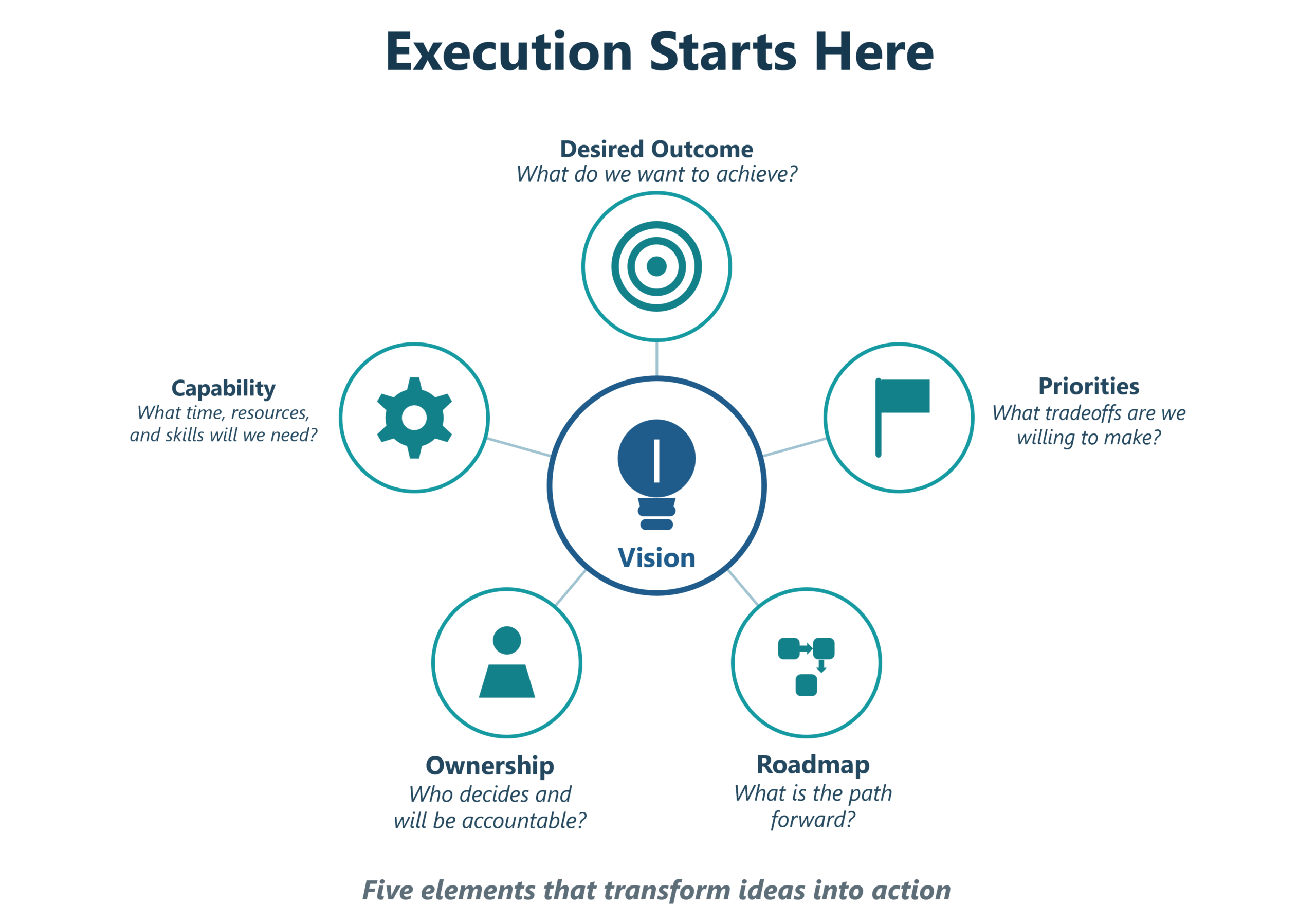
Experiences like this have convinced me that organizations often struggle because their good ideas have not yet been translated into five essential elements of coordinated action.
1. Desired Outcome
Do people agree on what will actually be delivered? Shared support for a vision is not the same as agreement on the outcome. Until the deliverables are clear, alignment is often an illusion.
2. Priorities
Have real tradeoffs been made? Does the organization have the resources and capacity to support its priorities? If everything is important, teams are forced to make their own judgments about what matters most. Their different choices lead to diverging outcomes.
3. Roadmap
Is there agreement on what must happen first? Important work often depends on prerequisites. Without deliberate sequencing, organizations can look busy but don’t build forward momentum.
4. Ownership
Who is accountable when decisions need to be made? Responsibility may appear clear at the leadership level but become vague where day-to-day work happens. Without deliberate attention from leaders, accountability naturally diffuses as work moves through the organization. This is especially true when a decision and its supporting rationale are not clearly documented. Teams may remember aspects of the decision but forget why it was made and the assumptions underlying it, creating confusion when conditions change later.
5. Capability
Does the organization have the time, resources, skills, and expertise to do the work? Even well-designed plans fail when commitments exceed available capacity or require capabilities the organization does not yet have. Sometimes those capabilities must be developed through training and experience or acquired by adding specialized expertise.
Where Execution Really Begins
You’re not done when you have an innovative idea. You’re done when it has been turned into work people can carry out consistently and together: step by step, with clear ownership, meaningful measures, and a way to adjust as reality changes.
A good idea creates the possibility of execution. It does not make execution happen on its own.
Similar challenges appear whenever work crosses organizational boundaries. In a previous article, I explored how programs help organizations turn effort into coordinated results.
Organizations can struggle for many reasons. But even the best ideas fail when they are not translated into a shared outcome, clear priorities, deliberate sequencing, accountable ownership, and the capabilities required to succeed.
That is where execution begins. That is how organizations transform ideas into action.